
- Home
- »
- Conventional Energy
- »
-
Floating LNG Terminals Market Size Report, 2026-2033GVR Report cover

Floating LNG Terminals Market (2026 - 2033)
Size, Share & Trends Analysis Report By Terminal Type (FSRUs, FLNGs), By Application (Import (Regasification), Export (Liquefaction)), By Region (North America, Europe, Asia Pacific, Latin America), And Segment Forecasts
Market Size, 2025
$8.3BMarket Estimate, 2026
$8.9BMarket Forecast, 2033
$15.1BCAGR, 2026–2033
7.8%Floating LNG Terminals Market Summary
The global floating LNG terminals market size was valued at USD 8.3 billion in 2025 and is projected to grow from USD 8.9 billion in 2026 to USD 15.1 billion by 2033, at a CAGR of 7.8% from 2026 to 2033. The market in Asia Pacific dominated with a revenue share of 35.0% in 2025. The market is expanding as a strategic solution for energy security, offering faster deployment and lower capital costs than onshore alternatives.
 Source: Grand View Research, IR Documents, Primary Interviews, Paid DatabasesTo learn more about this report,
 Download Free Sample Report
 Key Market Trends & Insights
- By terminal type: Floating storage and regasification units (FSRUs) segment held the largest market share of 66.5% in 2025.
- By application: Import (regasification) segment held the largest market share of 67.2% in 2025.
Regional Highlights
- Largest regional market: Asia Pacific (35.0% revenue share, 2025)
- Fastest-growing regional market: Latin America (highest CAGR, 2026-2033)
- By country: China held the largest market share in 2025
Market Size & Forecast
- Market size in 2025: USD 8.3 Billion
- Estimated market size in 2026: USD 8.9 Billion
- Projected market size by 2033: USD 15.1 Billion
- CAGR (2026-2033): 7.8%
Three ways to get this report
Buy it, customize it, or ask a question.Ask an Analyst
A direct answer, usually in 1 working day
- AccessReport author, directly
- Reply timeWithin 1 working day
- No sales callDirect answer only
- FormatEmail reply
- CostFree, no cost
Get the Full Report
What the study covers
- FormatsPDF · Excel · Dashboard
- Timeline2026–2033 annual, 2025 base
- Coverage20+ countries, 5 regions
- Companies10+ key players profiled
Customize the Report
20% free customization
- IncludeCountries, segments, points
- TailorTo your product definition
- ExtendDeeper competitor detail
- OrA fully bespoke study
- Turnaround5–10 working days
The market is witnessing strong growth as floating terminals offer a faster alternative to onshore construction, allowing countries to import LNG without lengthy terrestrial infrastructure projects. The global floating LNG terminals market is experiencing robust growth, driven by the need to bypass traditional, long-lead onshore construction, the shift toward cleaner energy sources, and the strategic necessity to access offshore gas reserves without extensivepipeline networks. The increasing complexity of global gas supply chains, coupled with the uneven distribution of natural gas reserves and consumption centers, is accelerating the adoption of floating LNG solutions for flexible and long-distance energy transportation. In addition, the development of advanced floating liquefaction and regasification technologies is enabling operators to enhance operational efficiency while minimizing infrastructure costs and deployment timelines. To learn more about this report, Download Free Sample Report
 Furthermore, the rising demand for cleaner energy sources, including natural gas as a transition fuel, is significantly influencing market expansion. Floating LNG terminals play a critical role in enabling flexible gas supply to remote and underserved regions while ensuring reliable energy access. Technological advancements, particularly in floating liquefaction and regasification systems, are improving operational efficiency, safety, and scalability. Simultaneously, ongoing investments in LNG infrastructure, along with increasing focus on energy security and supply diversification, are reinforcing the strategic importance of floating LNG terminals in supporting stable, efficient, and relatively lower-emission energy systems.
Drivers, Opportunities & Restraints
The primary driver of the floating LNG terminals market is the growing need for flexible and cost-effective LNG infrastructure to support global gas demand amid evolving energy security concerns. Government initiatives and strategic policies aimed at diversifying energy sources and reducing dependence on pipeline gas are accelerating the adoption of floating LNG solutions. Floating LNG terminals are increasingly preferred for their rapid deployment, lower capital requirements, and ability to be relocated based on demand. The rising need to monetize offshore and stranded gas reserves, particularly in regions lacking onshore infrastructure, is further strengthening the adoption of floating LNG terminal solutions.
A significant opportunity lies in the monetization of natural gas reserves and the integration of hybrid energy systems within the floating LNG terminals ecosystem. The deployment of FLNG technology enables the direct extraction and liquefaction of gas from remote and marginal offshore fields that are not economically viable for pipeline connectivity, thereby unlocking previously untapped resources. The increasing integration of floating LNG solutions with renewable energy sources, where LNG-based power serves as a stable, cleaner backup to intermittent wind and solar generation, is further enhancing system reliability and flexibility. Emerging economies across Asia Pacific, Latin America, and the Middle East & Africa are witnessing growing investments in offshore gas development and flexible energy infrastructure to meet rising demand. Furthermore, the expansion of hybrid energy models and the utilization of stranded reserves are creating new growth opportunities for floating LNG terminals.
However, the market faces operational and financial risks. Floating LNG terminals involve high ongoing costs, driven by the need for specialized vessels, advanced processing systems, and continuous offshore operations. Additionally, maintenance can be complex and expensive, as harsh marine environments require specialized equipment, skilled personnel, and regular servicing, increasing long-term operational expenses. Project viability can also be challenging, particularly in cost-sensitive or developing regions with limited funding availability. Furthermore, the lack of standardization across floating LNG designs and technologies can limit interoperability, often resulting in higher implementation costs and extended project timelines.
The floating LNG terminals industry faces several regulatory restraints that may hamper its growth trajectory. Project execution is often delayed because of inconsistent maritime and environmental regulations across jurisdictions. Additionally, the rapid growth of zero-emission alternatives like offshore wind and solar makes them increasingly cost-competitive, threatening the long-term viability of LNG in power generation.
Terminal Type Insights
The Floating Storage and Regasification Units (FSRUs) segment accounted for the largest market share of 66.5% in 2025, driven by its flexibility, cost-effectiveness, and rapid deployment capabilities for LNG import and regasification. FSRUs are widely used for supplying natural gas to regions where onshore terminal infrastructure is unavailable or economically unviable. These systems are particularly favored for their ability to be deployed quickly and relocated in response to changing demand, enabling efficient and reliable gas supply to power generation, industrial, and urban consumption centers. Additionally, the growing need for energy security and diversification of gas supply sources is further strengthening the adoption of FSRU-based floating LNG terminal solutions.
The Floating Liquefied Natural Gas Units (FLNGs) segment is projected to register the fastest CAGR of 9.1% over the forecast period, driven by its increasing adoption in offshore gas monetization applications. FLNG solutions are gaining significant traction as energy companies focus on developing remote and stranded offshore gas reserves without the need for extensive onshore infrastructure. Their ability to enable direct liquefaction, storage, and export of natural gas at sea makes them particularly well-suited for deepwater and isolated offshore fields. Additionally, growing investments in offshore exploration and production activities, along with the rising demand for flexible and cost-efficient LNG production solutions, are further accelerating segment growth.
Application Insights
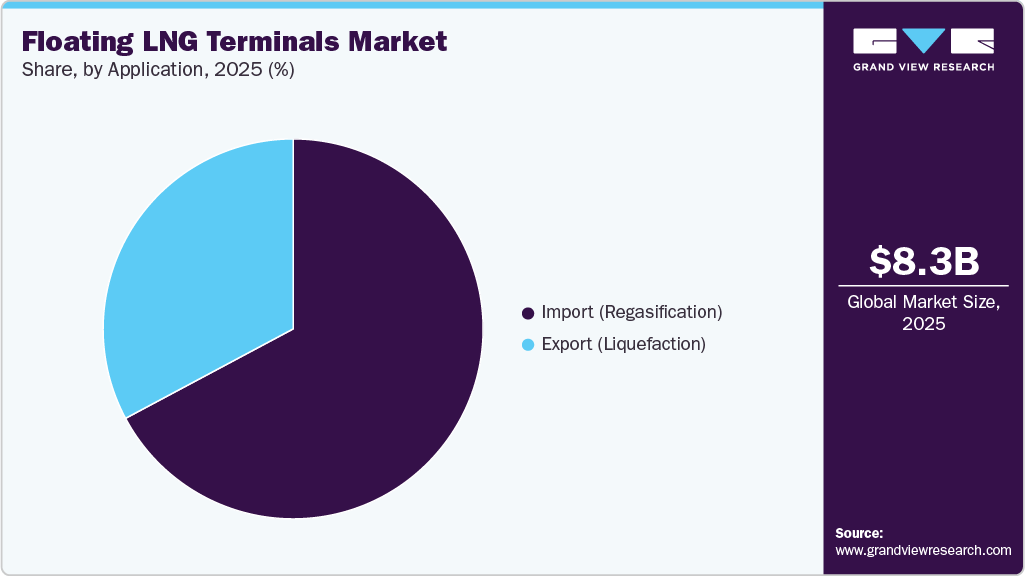
The import (regasification) segment dominated the floating LNG terminals industry, accounting for the largest revenue share of 67.2% in 2025, driven by the increasing need to convert LNG back into natural gas for distribution and consumption. Import terminals are critical components of floating LNG infrastructure, enabling rapid access to natural gas and facilitating supply to regions lacking pipeline connectivity. They are currently the dominant market segment, commanding a significant share of deployments, particularly in countries focused on enhancing energy security and diversifying gas supply sources.
 To learn more about this report, Download Free Sample Report
 The export (liquefaction) segment is projected to register the fastest CAGR of 9.1% over the forecast period, supported by increasing demand for efficient offshore gas monetization and expanding global LNG trade. Export-oriented floating LNG systems utilize advanced liquefaction technologies, representing a significant evolution from traditional onshore LNG plants and enabling flexible, scalable production solutions. The surge in investments in this segment is primarily driven by the development of offshore gas fields, rising demand for LNG exports, and the need to commercialize stranded gas reserves. Furthermore, growing focus on energy security and supply diversification is driving the deployment of floating liquefaction terminals, particularly in emerging economies with untapped offshore resources.
Regional Insights
Asia Pacific accounted for the largest revenue share of 35.0% in 2025, driven by rapid industrial growth, expanding urban populations, and a strong reliance on imported liquefied natural gas. Several countries across the region face limited domestic gas availability, making floating LNG terminals a key solution to enhance energy security and diversify supply sources. Moreover, supportive government policies and long-term LNG procurement initiatives are further driving infrastructure development. These floating terminals are widely used to manage peak energy demand and maintain grid stability, particularly in power generation applications.
 To learn more about this report, Download Free Sample Report
 The growth of the regional floating LNG terminals market is further supported by ongoing investments in LNG import infrastructure, offshore gas development, and advanced digital monitoring technologies that aim to enhance operational efficiency and system reliability. The increasing adoption of flexible regasification solutions, alongside the expansion of LNG trade networks and hybrid energy systems, is improving supply security and operational flexibility. This positions the Asia Pacific region as a leading and highly developed market for floating LNG terminals. Additionally, increasing industrial gas consumption, along with the shift from coal to cleaner energy alternatives, continues to strengthen the Asia-Pacific’s leading position in the global market.
The China floating LNG terminals market is a major global contributor, supported by itsexpanding LNG import infrastructure, large-scale project execution capabilities, and strong government backing. The country leads in the deployment of floating regasification terminals, driven by the need to supply natural gas to densely populated and industrialized coastal demand centers. China’s rapidly growing energy demand, coupled with its commitment to reducing carbon emissions, is accelerating investments in cleaner energy sources, including natural gas. Furthermore, continuous advancements in floating LNG technologies, along with increasing adoption of flexible and modular regasification solutions, are strengthening the country’s position as a key market in the global floating LNG terminals industry.
Europe Floating LNG Terminals Market Trends
Europe is experiencing steady growth in the floating LNG terminals industry, driven by an urgent need for energy security, diversification away from Russian pipeline gas, and rapid infrastructure deployment. Countries across the region are accelerating the transition toward more secure and flexible energy systems by expanding LNG import capacity and strengthening supply networks. Supportive policies and regulatory frameworks that promote energy diversification, infrastructure development, and supply resilience are driving the widespread deployment of floating LNG terminals across import and regasification projects.
North America Floating LNG Terminals Market Trends
North America is experiencing a steady growth in the floating LNG terminals industry, supported by increasing investments in LNG infrastructure and ongoing technological advancements. The region benefits from a well-developed energy ecosystem, with a growing emphasis on expanding LNG export capacity and enhancing global supply capabilities as part of the transition toward cleaner energy sources. Government support, favorable regulatory frameworks, and corporate investment strategies are driving the adoption of floating LNG solutions across offshore liquefaction and export projects.
Latin America Floating LNG Terminals Market Trends
The Latin America floating LNG terminals industry is expected to grow at the fastest CAGR of 9.9% over the forecast period. The growth is driven by the urgent need to monetize stranded offshore gas fields, energy security initiatives, and the requirement to bridge domestic gas supply deficits in countries like Colombia. The market is increasingly moving towards flexible, value-oriented solutions to minimize project risks. Although regulatory challenges and cost constraints persist, the region’s emphasis on infrastructure development and industrial growth continues to support stable long-term expansion.
Middle East & Africa Floating LNG Terminals Market Trends
The Middle East & Africa floating LNG terminals industry is expanding steadily, driven by the rising demand for cleaner energy options and the need for flexible power generation. Countries across the Middle East and Africa are increasingly adopting floating LNG technology as an alternative to conventional power solutions. This transition is supported by the region’s abundant natural gas reserves, which are being utilized to meet growing energy demand while reducing environmental impact.
Key Floating LNG Terminals Company Insights
The key participants in the global floating LNG terminals market are increasingly focusing on developing efficient and cost-competitive floating LNG solutions while ensuring long-term operational reliability. Additionally, strategic initiatives such as technological innovation, partnerships, and expansion into emerging markets are enabling them to strengthen their market position and influence industry dynamics.
Their operations typically encompass the design, development, ownership, and deployment of floating LNG terminals, offshore gas monetization projects, LNG import and regasification infrastructure, and integrated gas supply solutions to ensure efficient and reliable energy delivery. Industry leaders are placing strong emphasis on advanced floating liquefaction and regasification technologies to enhance operational flexibility, safety, and performance. Significant investments are being directed toward innovations in modular FLNG designs, cryogenic storage systems, and offshore processing technologies to improve efficiency and reduce project timelines. The integration of digital solutions such as artificial intelligence, predictive maintenance, and advanced monitoring platforms is enabling real-time performance optimization, improved asset management, and enhanced operational reliability.
As global demand for natural gas continues to rise and energy security becomes a critical priority, companies operating in the floating LNG terminals industry are prioritizing capacity expansion, strengthening supply chain resilience, and diversifying their geographic presence. Strategic collaborations, vertical integration across the LNG value chain, and increased investments in emerging economies are key growth strategies adopted by industry participants. Furthermore, evolving energy dynamics, including the growing role of LNG as a transition fuel, the expansion of global LNG trade, and the increasing adoption of flexible infrastructure solutions, are reshaping the competitive landscape. Continuous advancements in floating LNG technologies and offshore processing systems are expected to enhance market competitiveness and support the sustained growth of the global market.
Key Floating LNG Terminals Companies:
The following key companies have been profiled for this study on the floating lng terminals market.
- Shell plc
- Petroliam Nasional Berhad (PETRONAS)
- Eni S.p.A.
- Exxon Mobil Corporation
- Golar LNG Limited
- New Fortress Energy Inc.
- BW LNG
- Mitsui O.S.K. Lines Ltd.
- Hoegh LNG Holdings Ltd.
- Excelerate Energy Inc.
Recent Developments
-
In April 2025, Shell plc acquired a Singapore-based global LNG trading business, Pavilion Energy. This initiative aligns with Shell’s strategy to strengthen its leadership in the LNG market, expand its global LNG portfolio, and support sustained growth in liquefied natural gas sales.
-
In April 2026, Excelerate Energy introduced its latest FSRU, Excelerate Acadia, in South Korea. This move is in line with the company’s strategy to grow its floating LNG asset base, enhance global regasification capacity, and address increasing demand for adaptable and dependable LNG import infrastructure.
Floating LNG Terminals Market Report Scope
Report Attribute
Details
Market Definition
The Floating LNG Terminals market refers to the global revenue generated from the manufacturing, engineering, and development of floating LNG infrastructure, including floating storage and regasification units (FSRUs) and floating liquefied natural gas units (FLNGs), used for the import, export, and processing of liquefied natural gas.
Market size in 2025
USD 8.3 billion
Estimated market size in 2026
USD 8.9 billion
Projected market size by 2033
USD 15.1 billion
Growth rate
CAGR of 7.8% from 2026 to 2033
Base year for estimation
2025
Historical data
2021 - 2024
Forecast period
2026 - 2033
Quantitative Units
Revenue in USD million/billion and CAGR from 2026 to 2033
Report coverage
Revenue forecast, competitive landscape, growth factors, and trends
Segments covered
Terminal type, application, region
Regional scope
North America; Europe; Asia Pacific; Latin America; Middle East & Africa
Country scope
U.S.; Canada; Mexico; Germany; UK; France; Italy; Spain; Russia; China; India; Australia;Japan; South Korea; Brazil; Argentina;Saudi Arabia; UAE; South Africa
Key companies profiled
Shell plc; Petroliam Nasional Berhad (PETRONAS); Eni S.p.A.; Exxon Mobil Corporation; Golar LNG Limited; New Fortress Energy Inc.; BW LNG; Mitsui O.S.K. Lines Ltd.; Hoegh LNG Holdings Ltd.; Excelerate Energy Inc.
Customization scope
Free report customization (equivalent up to 8 analysts working days) with purchase. Addition or alteration to country, regional & segment scope.
Pricing and purchase options
Avail customized purchase options to meet your exact research needs. Explore purchase options
Global Floating LNG Terminals Market Report Segmentation
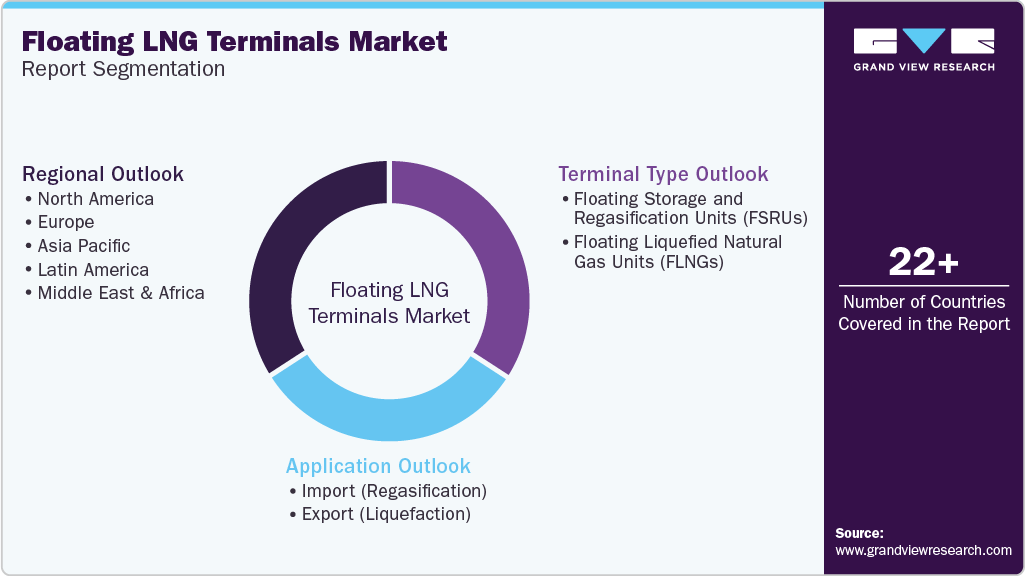
This report forecasts revenue growth at the global, regional, and country levels and provides an analysis of the latest industry trends in each of the sub-segments from 2021 to 2033. For this study, Grand View Research has segmented the global floating LNG terminals market report based on terminal type, application, and region:
 To learn more about this report, Download Free Sample Report
 -
Terminal Type Outlook (Revenue, USD Billion, 2021 - 2033)
-
Floating Storage and Regasification Units (FSRUs)
-
Floating Liquefied Natural Gas Units (FLNGs)
-
-
Application Outlook (Revenue, USD Billion, 2021 - 2033)
-
Import (Regasification)
-
Export (Liquefaction)
-
-
Regional Outlook (Revenue, USD Billion, 2021 - 2033)
-
North America
-
U.S.
-
Canada
-
Mexico
-
-
Europe
-
Germany
-
UK
-
France
-
Italy
-
Spain
-
-
Asia Pacific
-
China
-
India
-
Australia
-
Japan
-
South Korea
-
-
Latin America
-
Brazil
-
Argentina
-
-
Middle East & Africa
-
Saudi Arabia
-
UAE
-
South Africa
-
-
Frequently Asked Questions About This Report
The key factors driving the growth of the global floating LNG terminals market include the need for rapid deployment and operational flexibility, increasing focus on energy security and supply diversification, and the rising importance of offshore gas monetization.
The floating storage and regasification units (FSRUs) segment led with a 66.5% revenue share in 2025, while the floating liquefied natural gas units (FLNGs) segment is the fastest-growing.
The import (regasification) segment led with a 67.2% revenue share in 2025, while the export (liquefaction) segment is the fastest-growing.
The global floating LNG terminals market size was valued at USD 8.3 billion in 2025 and is estimated at USD 8.9 billion for 2026.
The global floating LNG terminals market is expected to grow at a CAGR of 7.8% from 2026 to 2033, reaching USD 15.1 billion by 2033.
Asia Pacific dominated with a 35.0% revenue share in 2025.
Latin America is the fastest-growing region over the forecast period.
Key players include Shell plc; Petroliam Nasional Berhad (PETRONAS); Eni S.p.A.; Exxon Mobil Corporation; Golar LNG Limited; New Fortress Energy Inc.; BW LNG; Mitsui O.S.K. Lines Ltd.; Hoegh LNG Holdings Ltd.; Excelerate Energy Inc.
About the Author(s)
Conventional Energy Research Team
Energy & Power · Conventional EnergyThis report was authored by the conventional energy research team at Grand View Research - comprising two research analysts, one senior research analyst, and one industry expert - with specialized expertise in the conventional energy segment of the energy & power industry. All findings are based on proprietary energy & power databases, executive interviews, and regulatory analysis, subject to internal peer review prior to publication.
Last Updated:
Speak to Analyst

Customize this report to your needs - add regions, segments, or data points, with 20% free customization.
Or view our licence options:


ISO 9001:2015 & 27001:2022 Certified
We are GDPR and CCPA compliant! Your transaction & personal information is safe and secure. For more details, please read our privacy policy.


